
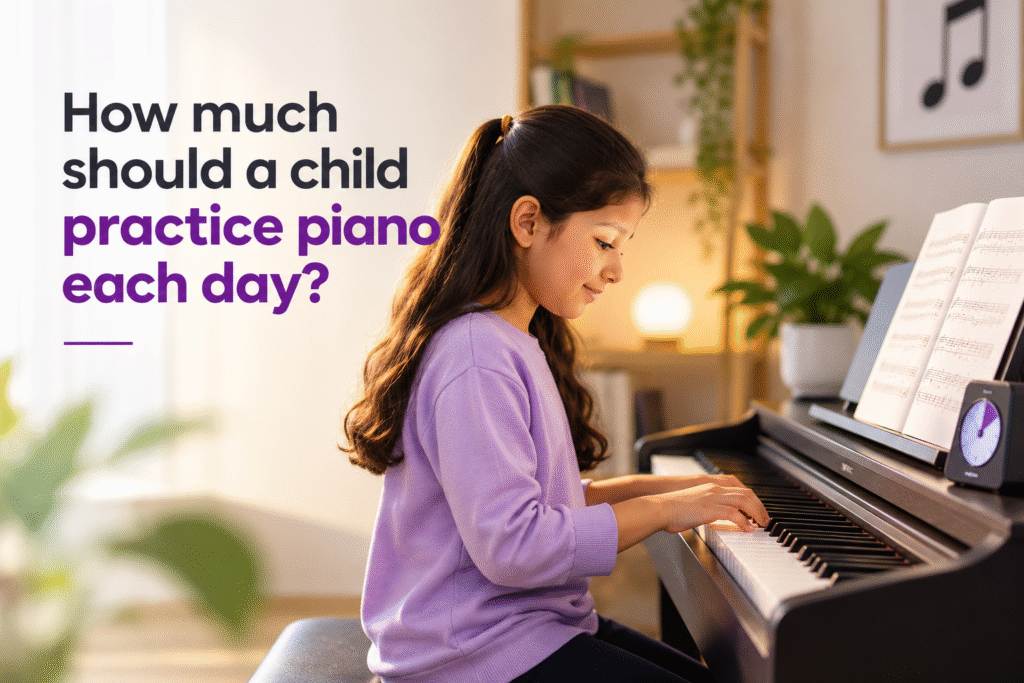
practice stalls progress, while too much can burn a child out or turn lessons into a chore. This article gives clear, realistic daily benchmarks by age, sample routines you can try this week, and parent-friendly tips to keep practice effective and enjoyable.
How much piano practice for kids — daily minutes by age
Below are sensible starting points for children who take weekly lessons. These are guidelines, not rules; use them as a baseline and adjust for your child’s energy, attention span and lesson goals.
Ages 4–5: 5–15 minutes a day
Young beginners have short attention spans. Keep sessions playful and focus on basic keyboard familiarity, simple songs and listening games. Aim for multiple very short sessions (2–3 a day) rather than one long sitting. Quality: engagement and curiosity.
Ages 6–8: 10–20 minutes a day
At primary-school age children can manage slightly longer sessions. A single 10–20 minute focused session after school or broken into two short bursts works well. Priorities: finger independence, reading simple notation, and playing short pieces with steady rhythm.
Ages 9–11: 20–30 minutes a day
Older primary and early secondary children can sustain longer practice. A daily 20–30 minute routine that combines warm-up, technical work and repertoire is a realistic target. This amount supports steady progress without overwhelming homework or other activities.
Ages 12–13: 30–45 minutes a day
Pre-teens approaching teenage routines often cope well with 30–45 minutes of focused
practice, especially if they are working toward graded exams, performances or ensemble playing. Split the time: warm-up and technique, scales, a study or etude, and at least one musical piece.
Beginners vs. more advanced students
-
-
-
- Absolute beginners: stay at the lower end of the range until basic coordination and reading develop.
-
-
-
-
-
- Motivated beginners who practice
-
-
-
-
-
- willingly can increase time gradually by 5–10 minutes every few weeks.
-
-
-
-
-
- More advanced children preparing for exams or concerts may need longer, but the extra time should be structured and goal-driven.
-
-
Why short, focused practice
beats long, unfocused sessions
Attention and concentration—not total minutes—drive improvement. A calm, focused 20-minute session with clear goals is more productive than an hour of distracted playing. Use simple measures of focus: correct tempo, few mistakes, and the ability to play a passage cleanly twice in a row.
Sample daily piano practice routines (easy to adapt)
10-minute routine (young beginner)
-
-
-
- 1 minute: sit and tune into the instrument; fingers on keys.
-
-
-
-
-
- 3 minutes: playful warm-up (finger games, simple five-finger patterns).
-
-
-
-
-
- 4 minutes: work on the lesson piece—small section only.
-
-
-
- 2 minutes: play a
favorite
-
-
-
- song for fun.
-
-
20-minute routine (typical beginner, age 6–9)
-
-
-
- 3 minutes: posture and slow warm-up (gentle finger exercises).
-
-
-
-
-
- 5 minutes: scales or basic technical patterns.
-
-
-
-
-
- 8 minutes: stop-and-fix practice on the lesson piece (small sections, hands separately if needed).
-
-
-
-
-
- 4 minutes: play-through of a familiar piece for enjoyment.
-
-
35–45 minute routine (older student)
-
-
-
- 5 minutes: focused warm-up and scale
-
-
practice
-
-
-
- .
-
-
-
-
-
- 10–15 minutes: technical work (arpeggios, controlled passages).
-
-
-
-
-
- 10–15 minutes: main repertoire — break into short goals and repeat problem bars slowly.
-
-
-
-
-
- 5–10 minutes: sight-reading and a free play section for musicality.
-
-
Practical practice tips for parents
-
-
-
- Set a predictable slot: link
-
-
practice
-
-
-
- to a regular time (after snack, before homework) so it becomes a habit.
-
-
-
-
-
- Use focused goals: tell your child what to achieve in the session (e.g. “play bars 5–12 at 60 bpm”).
-
-
-
-
-
- Break tasks into tiny steps: isolate problem bars,
-
-
practice
-
-
-
- hands separately, then slowly combine.
-
-
-
- Keep it
multi sensory
-
-
-
- : clap rhythms, sing melodies, or mark fingering spots to reinforce learning.
-
-
-
-
-
- Use a timer or visual cue: a five-minute sand timer or countdown app helps children concentrate for short bursts.
-
-
-
-
-
- Positive reinforcement: praise effort and improvement rather than perfection. Celebrate small wins.
-
-
-
-
-
- Avoid punishment-based practice
-
-
-
-
-
- : forcing long sessions damages motivation more than it improves skill.
-
-
When to increase or decrease practice time Increase practice time if:
-
-
-
- Your child consistently completes practice goals and asks for more time.
-
-
-
-
-
- They have a specific target (concert, exam) and can tolerate structured extra work.
-
-
Decrease or pause increases if:
-
-
-
- Practice becomes a daily battle and interest drops.
-
-
-
-
-
- Your child shows signs of fatigue, avoidance, or persistent frustration with no progress.
-
-
Signs a practice routine is working
-
-
-
- Weekly lessons show clear, incremental improvement in pieces or technique.
-
-
-
-
-
- Your child can play small sections more cleanly than a few weeks earlier.
-
-
-
-
-
- They demonstrate curiosity—asking about a passage, trying a new style, or improvising.
-
-
What to do if your child resists practicing
Resentment often stems from boredom, unclear expectations, or too-large tasks. Try these steps:
-
-
-
- Cut the session to a length they can manage and make it fun.
-
-
-
-
-
- Offer choice—let them pick a short piece or a creative task (compose a short melody, play a game).
-
-
-
-
-
- Split practice
-
-
-
-
-
- into two shorter sessions during the day.
-
-
-
-
-
- Discuss the lesson with their teacher to align home tasks with lesson priorities.
-
-
How lessons and practice
fit together
Lessons set direction; home
practice turns guidance into skill. If you want a structured lesson format that complements sensible daily
practice, Sound Garage offers 60-minute 1-to-1 live online music classes that make it easy to follow a teacher’s plan. Sound Garage currently offers Piano/Keyboard, Guitar, Violin, Drums, Western Vocals, Hindustani Vocals and Carnatic Vocals, and provides a free trial lesson so you can see whether their approach suits your child.
Students pay for 4 classes at a time; the next payment becomes due after 4 completed classes. Missed or rescheduled classes do not count as completed classes. There is no long-term payment commitment beyond the current 4-class cycle.
If you prefer to explore structured lessons that match practical at-home routines, consider booking a free trial with Sound Garage to see how a teacher plans
practice between lessons: online piano classes.
Quick checklist for starting a realistic practice
routine
-
-
-
- Set a short, predictable daily slot.
-
-
-
-
-
- Use a simple, written goal for each session.
-
-
-
-
-
- Keep sessions short and focused for young learners.
-
-
-
-
-
- Celebrate progress and adjust time based on engagement.
-
-
-
-
-
- Coordinate with the teacher each lesson to set achievable home tasks.
-
-
Good piano
practice for kids balances consistency, focused goals and plenty of enjoyment. Start small, measure progress in small wins, and increase time only when your child is ready. If you’d like a structured lesson to support home
practice, you can try a free trial lesson or learn more about their approach via Sound Garage’s online piano classes.
Frequently asked questions
How many minutes a day should a 7-year-old practice
piano?
A sensible starting point is 10–20 minutes a day, split into one or two short sessions. Focus on small, achievable goals rather than total time.
Is it better to practice
every day or have longer sessions a few times a week?
Short daily
practice builds muscle memory and steady progress far more effectively than infrequent long sessions. Aim for daily if possible, even when it’s brief.
What should a 20-minute practice
session include?
Warm-up (3–5 minutes), short technical work (scales or patterns, 5 minutes), focused work on a lesson piece (8–10 minutes) and a brief fun play-through to finish.
How quickly should I expect progress?
Progress varies. Look for small, consistent improvements across weeks—cleaner passages, fewer mistakes and rising confidence. If you don’t see that, discuss adjustments with the teacher.
Can online lessons work with home practice?
Yes. Live 1-to-1 lessons can be particularly effective because the teacher sets specific home goals and demonstrates exactly what to
practice. If you want to try that format, Sound Garage offers 60-minute 1-to-1 live online music classes and a free trial lesson.