By Sound Garage • Updated 2025 • 7 min read
Introduction
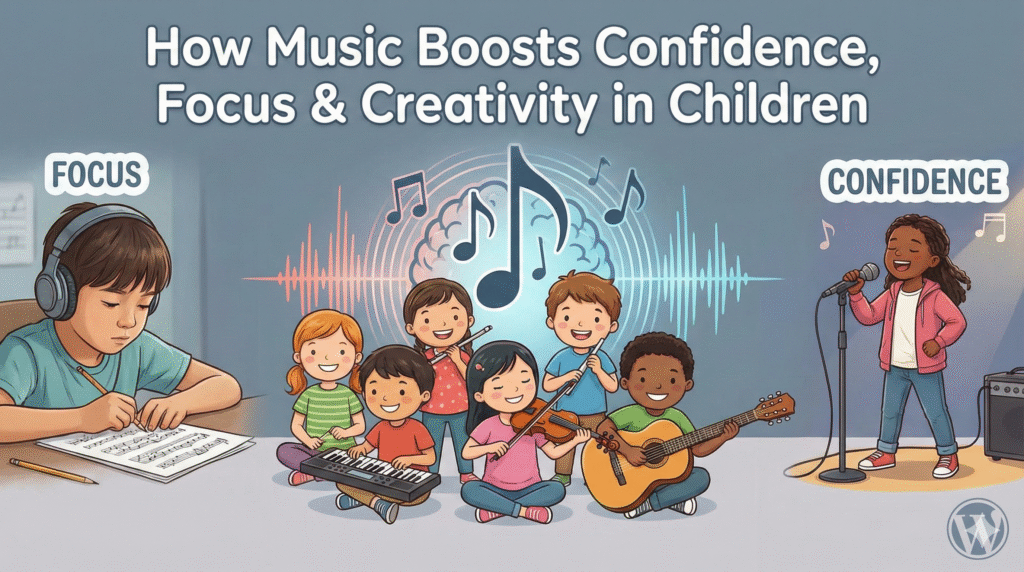
Every parent wants their child to grow into a confident, expressive, and emotionally strong individual.
But in today’s fast-paced world, with screens everywhere and academic pressure rising, children often lose the space to explore their creativity or build self-belief.
This is where music becomes a gift — one that quietly shapes a child’s emotional and mental development in ways most parents don’t realize.
For children aged 6–13, learning music is more than just playing an instrument.
It strengthens their mind, nourishes their creativity, helps them focus better, and boosts their confidence from the inside out.
Let’s explore how.
1. Music Builds True, Lasting Confidence
Children feel confident when they can do something well — and music gives them countless opportunities to achieve small wins each week.
- Learning a new melody
- Mastering a technique
- Performing a piece
- Getting positive feedback
- Seeing their own progress
Each step tells the child:
“I can do this.”
Over time, these consistent wins help children:
- Speak more confidently
- Believe in their abilities
- Approach challenges without fear
- Handle stage presence and performance anxiety
Even shy children experience a remarkable transformation through music.
2. Music Improves Focus and Concentration
Playing an instrument requires a child to do multiple things at once:
- Read notes
- Count rhythm
- Control technique
- Listen to sound quality
- Coordinate both hands
This multi-layered activity strengthens the brain areas responsible for attention, memory, and concentration.
Parents often notice improvements in:
- Homework focus
- School performance
- Listening ability
- Patience
- Overall discipline
Music teaches the mind to slow down, process, and stay present — a rare skill in today’s distracted world.
3. Music Unlocks Creativity and Imagination
Children naturally express themselves through movement, sound, and imagination.
Music gives them a structured yet free space to explore all of this.
When children learn music, they:
- Discover new sounds
- Experiment with melodies
- Interpret emotions
- Create their own musical ideas
- Use imagination in a meaningful way
Creativity is not just for artists — it helps in problem-solving, emotional balance, and innovative thinking.
Music naturally develops this inner creative engine.
4. Music Strengthens Emotional Expression
Children don’t always have the words to express their feelings, but they can express them through music.
- Playing a soft piece helps them calm down
- Playing something energetic lifts their mood
- Learning new pieces helps them channel emotions
- Expressive playing helps them feel understood
Music becomes a safe emotional outlet — a place where children feel calm, focused, and connected to themselves.
This emotional grounding helps children:
- Handle stress better
- Build resilience
- Express emotions without fear
- Develop empathy and sensitivity
5. Music Encourages Discipline and Responsibility
Every time your child practices, they are learning discipline — without being forced into it.
Music teaches:
- Routine
- Goal-setting
- Patience
- Accountability
- Time management
These are life skills that help children grow into more responsible, grounded individuals.
6. Music Builds Strong Memory and Brain Development
Research shows that children who learn music develop stronger:
- Memory retention
- Cognitive abilities
- Listening skills
- Neural connections
- Spatial and mathematical understanding
The structured nature of music lessons — especially with graded systems like Trinity — creates a strong mental foundation.
7. Music Helps Children Feel Proud of Their Progress
One of the most rewarding moments for a parent is seeing their child:
- Perform a piece
- Share their progress
- Play confidently in front of family
These moments boost self-esteem in a powerful way.
Children learn:
“If I put effort into something, I can achieve it.”
This becomes a core belief that shapes their approach to school, friendships, and life.
Why Ages 6–13 Are the Best Time to Start
Children in this age group:
- Learn faster
- Absorb skills easily
- Show natural curiosity
- Are emotionally expressive
- Build habits quickly
- Respond beautifully to encouraging teachers
Starting early gives them a lifelong advantage — musically, emotionally, and mentally.
How Sound Garage Supports Your Child’s Growth
Sound Garage isn’t just a place to “learn songs.”
It’s a nurturing space where children experience the full developmental benefits of music.
Our approach is built on:
- Young, relatable tutors
- Trinity-certified performers
- One-on-one attention
- A warm learning atmosphere
- Fun, modern teaching methods
- Regular performance practice
Children don’t just learn music — they grow with it.
Parents often tell us:
“My child is more focused now.”
“My daughter’s confidence has increased so much.”
“My son expresses himself more openly.”
“My child has become more disciplined.”
These changes are real — and they last.
Want to Help Your Child Build Confidence Through Music?
If you’d like to see how your child responds to music learning, you can try a free demo class.
A single session is enough to see:
- Comfort level
- Confidence
- Interest
- Connection with the tutor
It’s a simple first step that could shape your child’s growth for years to come.
Suggested Related Articles
- Finding Quality Music Education Abroad
- Trinity Piano Classes Online
- Online vs Offline Piano Classes: What’s Best for Your Child?
About Sound Garage
Sound Garage is an online music school built by performers, composers, and Trinity-certified musicians.
We help children aged 6–13 across the world grow in confidence, creativity, and discipline through structured, enjoyable online music lessons.